When discussing weights, the measurement of 756 ounces is significant in various contexts, particularly in fields like cooking, shipping, and science. To provide a clear understanding, it's essential to note that 756 ounces is equivalent to 47.25 pounds, as there are 16 ounces in a pound. This conversion is crucial for those involved in weight-sensitive industries, such as freight and logistics, where accurate measurements can impact shipping costs and efficiency. In culinary settings, understanding this weight helps chefs and bakers accurately portion ingredients, ensuring consistency and quality in their dishes. Additionally, for fitness enthusiasts and health professionals, being aware of weight conversions can assist in tracking dietary intake and exercise regimens. Overall, whether you are measuring ingredients in the kitchen, calculating shipping weights, or analyzing data in a scientific study, the precise understanding of 756 ounces can play an important role in achieving your objectives.
756 oz to g
756 Ounces to Grams
756 Ounce to Gram converter
Understanding the mass of 756 ounces, which is equivalent to approximately 21,432.24 grams, is essential for various applications in fields such as science, cooking, and manufacturing. This specific mass measurement can be particularly relevant for industries that require precise weight specifications, including food production, pharmaceuticals, and materials engineering. The conversion from ounces to grams is a fundamental aspect of weight measurement, as ounces are often used in the United States while grams are more commonly employed in scientific and international contexts. To convert ounces to grams, one can apply the conversion factor where 1 ounce is equal to approximately 28.3495 grams. Therefore, to convert 756 ounces to grams, the calculation would be 756 multiplied by 28.3495, yielding the result of 21,432.23948628 grams. This level of detail is significant in contexts where accuracy is paramount, such as in laboratory settings or when formulating recipes that require exact measurements. In culinary applications, understanding this mass can be beneficial for chefs and food manufacturers who need to scale recipes or ensure consistency in product formulations. For instance, a recipe that calls for 756 ounces of an ingredient can be easily adapted for larger or smaller batches by converting this measurement into grams, allowing for precise ingredient proportions. In scientific research, the ability to accurately convert and understand mass measurements is crucial for experiments, data analysis, and reporting. The precision of 21,432.24 grams can be critical when measuring substances, especially in chemistry and biology where reactions and interactions often depend on exact quantities. Moreover, when dealing with logistics and shipping, knowing the mass in both ounces and grams can facilitate better inventory management and compliance with international shipping regulations, which may require weights to be reported in grams. Understanding the implications of mass measurements like 756 ounces or 21,432.24 grams extends beyond simple conversions; it plays a vital role in ensuring accuracy and consistency across various sectors. Whether for culinary precision, scientific accuracy, or logistical efficiency, grasping the significance of this mass can enhance processes and outcomes in numerous professional fields.
How to convert 756 Ounces to Gram?
| 756 oz * | 28.349523 g | = 21432.239483 g |
| 1 oz |
A common question is How many ounce in 756 gram? And the answer is 26.667115 oz in 756 g. Likewise the question how many gram in 756 ounce has the answer of 21432.239483 g in 756 oz.
How much are 756 Ounces in Grams?
756 Ounces equal 21432.239483 Grams (756 oz = 21432.239483 g). Converting 756 oz to g is easy. Simply use our calculator above, or apply the formula to change the length 756 oz to g.
Convert 756 oz to common Mass
| Unit | Mass |
|---|---|
| Microgram | 21432239482.5 µg |
| Milligram | 21432239.4825 mg |
| Gram | 21432.239483 g |
| Kilogram | 21.432239 kg |
| Pound | 47.25 lb |
| Stone | 3.375 st |
| US ton | 0.023625 ton |
| Tonne | 0.021432 t |
| Imperial ton | 0.021094 Long ton |
What is 756 Ounces in g?
To convert 756 oz to g multiply the Mass in by 28.349523125. The 756 oz in g formula is [g] = 756 * 28.349523125. Thus, for 756 Ounces in Gram we get 21432.239483 g.
756 Ounce Conversion Table
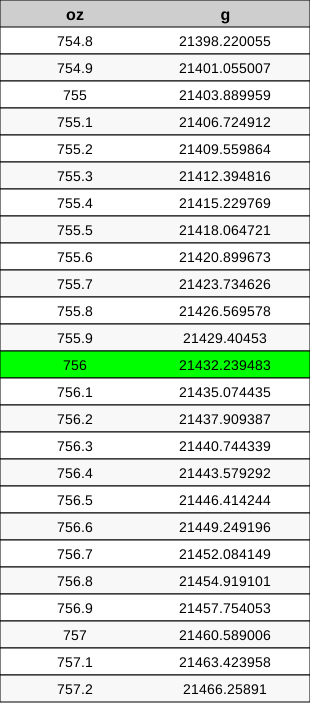
Further Ounce to Gram calculations
- 746 oz to Grams
- 747 Ounces to g
- 748 oz to g
- 749 oz to Grams
- 750 Ounces to g
- 751 Ounces to g
- 752 oz to g
- 753 oz to Grams
- 754 oz to Grams
- 755 Ounces to g
- 756 Ounces to Gram
- 757 Ounces to g
- 758 Ounces to Grams
- 759 Ounces to Grams
- 760 Ounces to Gram
- 761 Ounces to g
- 762 oz to Grams
- 763 oz to Gram
- 764 oz to Grams
- 765 oz to Gram
- 766 Ounces to g
Alternative spelling
756 oz to g, 756 oz into g, 756 oz in g, 756 Ounce to Gram, 756 Ounce into Gram, 756 Ounce in Gram, 756 Ounces to Grams, 756 Ounces into Grams, 756 Ounces in Grams, 756 Ounce to g, 756 Ounce into g, 756 Ounce in g, 756 oz to Gram, 756 oz into Gram, 756 oz in Gram, 756 Ounces to g, 756 Ounces into g, 756 Ounces in g, 756 oz to Grams, 756 oz into Grams, 756 oz in Grams
Further Languages
- 756 Ounces To Grams
- 756 Унция в Грам
- 756 Unce Na Gram
- 756 Unse Til Gram
- 756 Unze In Gramm
- 756 Ουγγιά σε Γραμμάριο
- 756 Onza En Gramo
- 756 Unts Et Gramm
- 756 Unssi Gramma
- 756 Once En Gramme
- 756 Unca U Gram
- 756 Uncia Gramm
- 756 Oncia In Grammo
- 756 Uncija Iki Gramas
- 756 Uqija Fil Gramma
- 756 Ons Naar Gram
- 756 Uncja Na Gram
- 756 Onça Em Grama
- 756 Uncie în Gram
- 756 Unca Na Gram
- 756 Uns Till Gram
- 756 ons In Gram
- 756 غرام إلى أونصة
- 756 Unsiyası Qram
- 756 আউন্স মধ্যে গ্রাম
- 756 Unça A Gram
- 756 औंस से ग्राम
- 756 Ons Ke Gram
- 756 オンス・トゥ・グラムス
- 756 온스 그램
- 756 Unse Til Gram
- 756 Унция в Грамм
- 756 Unča V Gram
- 756 Dërhemi Në Grami
- 756 ออนซ์กรัม
- 756 ઔંસ ગ્રામ
- 756 Ons Gram
- 756 Унція в грам
- 756 Ounce Sang Gam
- 756 盎司为克
- 756 盎司至克
- 756 Ounces To Grammes