1250 in to mm
1250 Inches to Millimeters
1250 Inch to Millimeter converter
When discussing measurements, the length of 1250 inches, which converts to 31750 millimeters, can be significant in various fields, including construction, manufacturing, and design. Understanding this measurement in both inches and millimeters is essential for accuracy and precision in projects that require detailed specifications. In the United States, measurements are often provided in inches, whereas many other countries use the metric system, where millimeters are commonly employed. This duality in measurement systems highlights the importance of converting between inches and millimeters to ensure that all stakeholders are on the same page, particularly in international projects. In practical applications, 1250 inches may be relevant for the dimensions of large-scale structures, such as beams, panels, or equipment. For example, in construction, a structural beam that measures 1250 inches in length could be crucial for the integrity of a building, providing necessary support and stability. Similarly, in manufacturing, components that measure 31750 millimeters are often used in machinery and production lines, where precise measurements are critical for functionality and safety. When converting between inches and millimeters, it is important to use the correct conversion factor. The standard conversion rate is that one inch equals 25.4 millimeters. Therefore, to convert 1250 inches to millimeters, one would multiply 1250 by 25.4, resulting in 31750 millimeters. This conversion is vital for engineers, architects, and designers who need to work with both measurement systems to create plans and specifications that meet regulatory standards and client expectations. In the context of design and engineering, understanding the significance of 1250 inches can also influence the choice of materials and construction techniques. For instance, construction materials such as steel and wood are often sold in standard lengths, and knowing that a specific length is 1250 inches helps professionals select the appropriate size or determine if cutting is necessary. Additionally, in product design, the dimensions of 31750 millimeters may dictate the overall size of the product, impacting its usability and marketability. Furthermore, in industries such as textiles and automotive, precise measurements are crucial for functionality and aesthetics. A textile roll that is 1250 inches long allows for a specific number of garments to be produced, while automotive parts must adhere to exact specifications to ensure proper fit and safety. When it comes to optimizing online content related to lengths such as 1250 inches or 31750 millimeters, it is essential to use relevant keywords and phrases that potential users might search for. Keywords may include "inches to millimeters conversion," "large measurement specifications," "construction beam lengths," or "manufacturing dimensions." By incorporating these keywords naturally into the content, businesses and professionals can improve their search engine visibility and connect with audiences seeking information related to these lengths. In conclusion, the length of 1250 inches or 31750 millimeters holds significant value across various industries. Whether in construction, manufacturing, or design, understanding and accurately converting these measurements is essential for successful project execution. As professionals continue to navigate the complexities of both imperial and metric systems, the importance of precise measurements remains paramount in achieving quality and safety in their work.
How to convert 1250 Inches to Millimeter?
| 1250 in * | 25.4 mm | = 31750 mm |
| 1 in |
A common question is How many inch in 1250 millimeter? And the answer is 49.212598 in in 1250 mm. Likewise the question how many millimeter in 1250 inch has the answer of 31750 mm in 1250 in.
How much are 1250 Inches in Millimeters?
1250 Inches equal 31750 Millimeters (1250 in = 31750 mm). Converting 1250 in to mm is easy. Simply use our calculator above, or apply the formula to change the length 1250 in to mm.
Convert 1250 in to common Lengths
| Unit | Length |
|---|---|
| Nanometer | 31749999999.999996 nm |
| Micrometer | 31750000 µm |
| Millimeter | 31750 mm |
| Centimeter | 3175 cm |
| Foot | 104.166667 ft |
| Yard | 34.722222 yd |
| Meter | 31.75 m |
| Kilometer | 0.03175 km |
| Mile | 0.019729 mi |
| Nautical Mile | 0.017144 nmi |
What is 1250 Inches in mm?
To convert 1250 in to mm multiply the Lengths in by 25.4. The 1250 in in mm formula is [mm] = 1250 * 25.4. Thus, for 1250 Inches in Millimeter we get 31750 mm.
1250 Inch Conversion Table
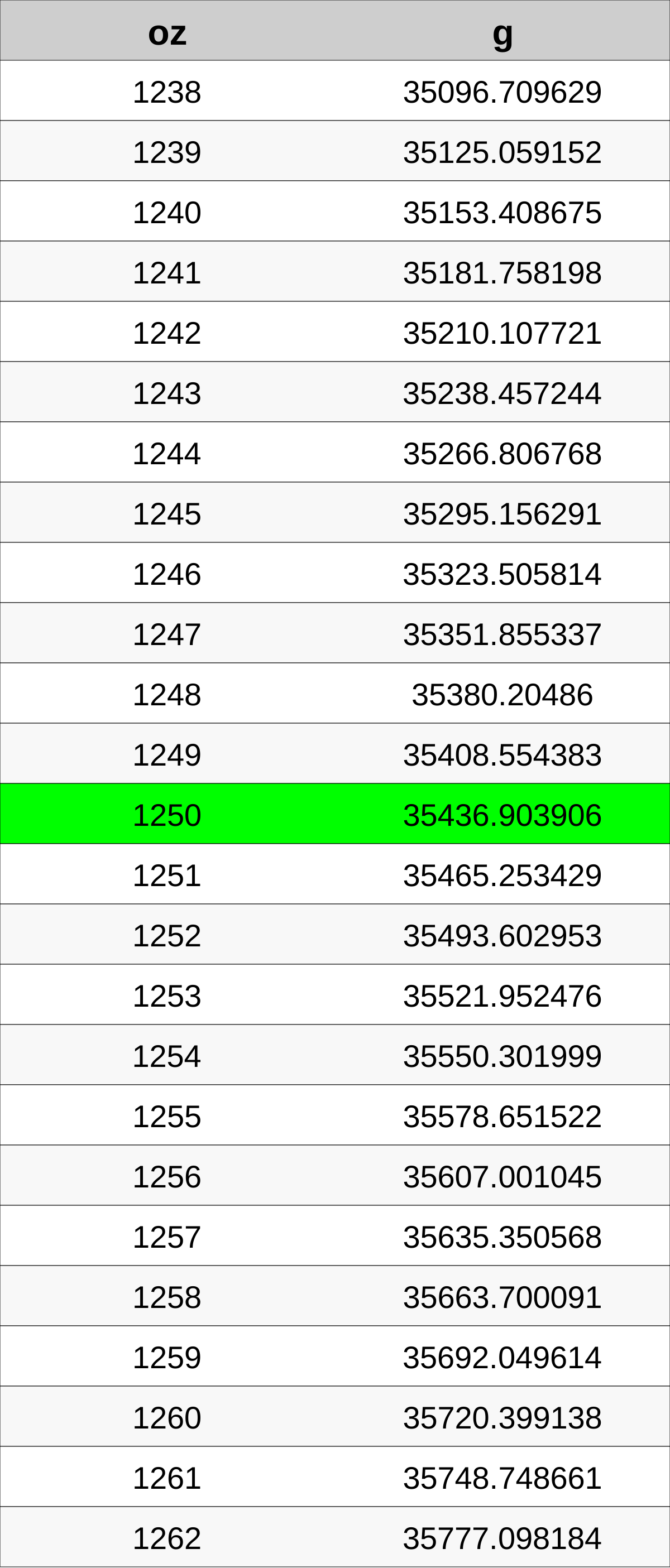
Further Inch to Millimeter calculations
- 1150 Inches to mm
- 1160 in to Millimeters
- 1170 Inches to mm
- 1180 in to mm
- 1190 in to mm
- 1200 in to Millimeter
- 1210 in to mm
- 1220 Inches to mm
- 1230 Inches to mm
- 1240 in to mm
- 1250 in to mm
- 1260 Inches to Millimeter
- 1270 Inches to Millimeters
- 1280 Inches to Millimeter
- 1290 in to Millimeter
- 1300 in to Millimeter
- 1310 Inches to Millimeters
- 1320 Inches to Millimeter
- 1330 Inches to Millimeter
- 1340 in to Millimeter
- 1350 Inches to Millimeters
Alternative spelling
1250 in to mm, 1250 in into mm, 1250 in in mm, 1250 Inch to Millimeter, 1250 Inch into Millimeter, 1250 Inch in Millimeter, 1250 Inches to Millimeters, 1250 Inches into Millimeters, 1250 Inches in Millimeters, 1250 Inch to mm, 1250 Inch into mm, 1250 Inch in mm, 1250 in to Millimeter, 1250 in into Millimeter, 1250 in in Millimeter, 1250 Inches to mm, 1250 Inches into mm, 1250 Inches in mm, 1250 in to Millimeters, 1250 in into Millimeters, 1250 in in Millimeters
Further Languages
- 1250 Inches To Mm
- 1250 инч в милиметър
- 1250 Palec Na Milimetr
- 1250 Tomme Til Nillimeter
- 1250 Zoll In Millimeter
- 1250 ίντσα σε χιλιοστόμετρο
- 1250 Pulgada En Milímetro
- 1250 Toll Et Millimeeter
- 1250 Tuuma Millimetri
- 1250 Pouce En Millimètre
- 1250 Palac U Milimetar
- 1250 Hüvelyk Milliméter
- 1250 Pollice In Millimetro
- 1250 Colis Iki Milimetras
- 1250 Pulzier Fil Millimetr
- 1250 Inch Naar Millimeter
- 1250 Cal Na Milimetr
- 1250 Polegada Em Milímetro
- 1250 Țol în Milimetr
- 1250 Palec Na Milimeter
- 1250 Inch Till Millimeter
- 1250 Duim In Millimeter
- 1250 مليمتر إلى بوصة
- 1250 Düym Millimetr
- 1250 ইঞ্চি মধ্যে মিলিমিটার
- 1250 Polzada A Mil·límetre
- 1250 इंच से मिलीमीटर
- 1250 Inci Ke Milimeter
- 1250 ミリメートルまでのインチ
- 1250 인치 밀리미터
- 1250 Tomme Til Millimeter
- 1250 дюйм в миллиметр
- 1250 Palec V Milimeter
- 1250 Inç Në Milimetri
- 1250 นิ้วมิลลิเมตร
- 1250 ઇંચ મિલિમીટર
- 1250 İnç Milimetre
- 1250 дюйм в міліметр
- 1250 Inch Sang Milimét
- 1250 英寸为毫米
- 1250 英寸至毫米
- 1250 Inches To Millimetres